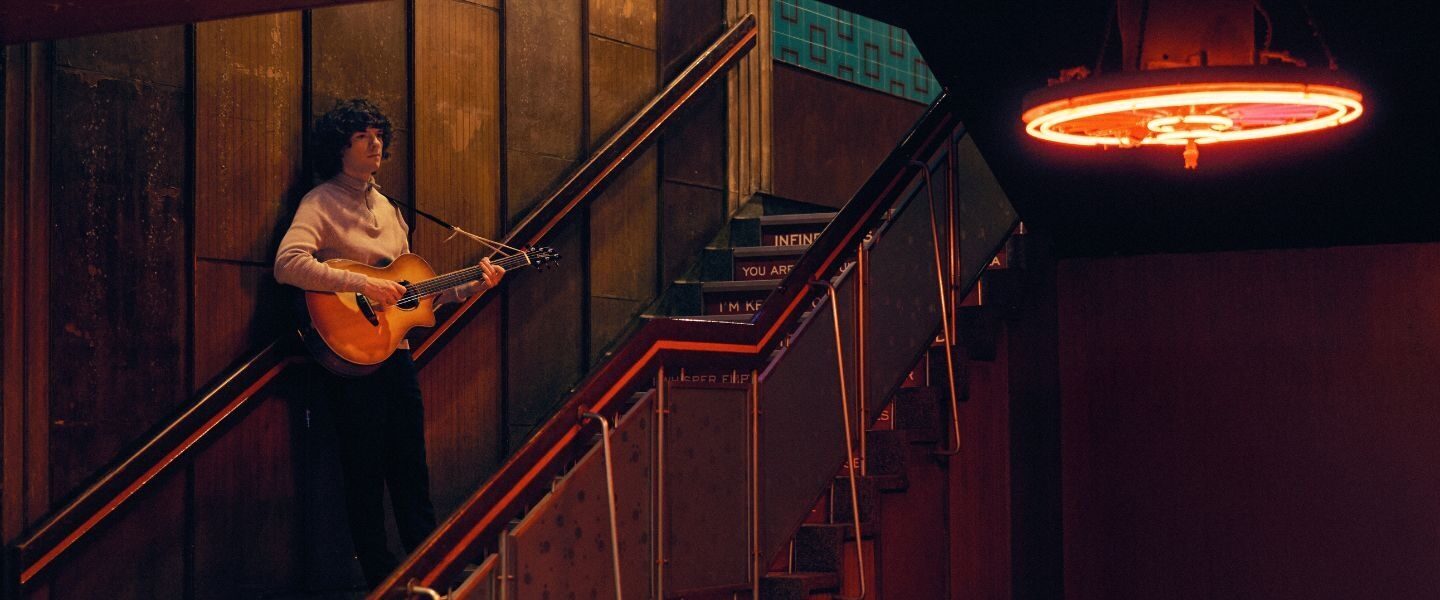
Dylan John Thomas Announces Much-Anticipated Show at P&J Live
Dylan John Thomas, Scottish singer and songwriter discovered by Gerry Cinnamon, has announced a show at Aberdeen’s P&J Live, which is set to host an electrifying all-standing performance in Hall C on Saturday 12th December 2026.
Forty million streams and 60,000 tickets can’t be wrong. The numbers don’t lie, and nor do the tunes – impassioned songs of love and regret, faith and fatalism, rejection and connection, realism and idealism.
After selling out six nights at the Barrowlands, Dylan John Thomas is Scotland’s worst kept musical secret. From pavement to arena, the DIY artist who did it all for himself, all the way to a sell-out homecoming show at Glasgow’s 14,300-capacity Ovo Hydro. A self-taught, multi-instrumentalist, mainlining the old-time rhythm of Johnny Cash (“boom-chicka-boom…”), the high-picking melodies of Simon & Garfunkel, the lyrical poeticism of Leonard Cohen – but all retooled with a twentysomething’s freshness, rigour and vigour, and the ardent fandom to match. Boom-chicka-BOOM.
His second album, Nothing Here Worth Taking, was recorded at Magic Box studios over the past year with Scotty Anderson (The Snuts). Entirely written by Dylan, with most of the instruments self-played too, the 10-track set is a rousing, carousing blast of brass, blues, banjo, piano and classic, retro-futureproof, singalong songwriting.
That spirit is there in vivid form on lead single ‘Got You on My Mind’. The first song completed for the album, it’s a banjo-and brass-driven anthem. “I got into banjo two years ago, just after the first album came out,” Dylan explains. “We went on a wee trip round Scotland, and I took it with us. We were just kicking around, playing all the old folk songs. And by the time it came to recording this album, I'd written a couple of songs on it.”
“It gives a different type of sound to the guitar. It’s still sticking within that bluegrass feel, I suppose, with the rolling fingerpicking. But I wanted to see if we could fit it into the new tunes.”
The thrilling blast of brass is also there in the title track, a song of encouragement and support for a mate whose relationship was breaking down. That brass sound, he explains, calls back to the ska he loved as a kid. ‘Nothing Here Worth Taking’ and ‘Got You on My Mind’ represent the overall palette of the album: “It's an amalgamation of all different kind of influences pulled together to create the sound. Which seems to kick off live all around the country.”
That music was first showcased in 2024’s self-titled debut album. Rousing and impassioned, it’s a record that distilled everything Dylan had learned growing up as a kid in foster care and finding his way. Mentored by Gerry Cinnamon and hand-picked for arena-scale supports slots by Liam Gallagher, Sam Fender and Stereophonics, his is a story of letting his music do the talking, the fans do the shouting and the music industry playing catch-up.
That word-of-mouth enthusiasm was built by Dylan and the band-of-brother mates who play with him over years of grassroots gigging. Like Cinnamon, the Scottish “unknown” who sold out the country’s national football stadium Hampden (twice), behind a microphone is where Dylan is at his most eloquent.
“Aye, it's been a bit mad,” he acknowledges with a wry grin of his fans know-all-the-words fervour. “To headline at arena level off the back of first album was mental.”
Dylan’s introduction to music was unconventional.
“In the foster house, we were always on the PlayStation. Tony Hawk skateboarding was the game we had at the time. I say that we used to play it: it was just a bunch of boys elbowing each other out of the way – everybody trying to grab the controller!” he remembers, smiling.
If the controller was out of reach, the rest would just listen to the soundtrack. “Ring of Fire would come on every five minutes, and we'd all be jumping around the room singing it. Through that, I ended up asking for a guitar that Christmas, and Ring of Fire was the first song that I learned. Listening to Johnny Cash then naturally evolved into listening to different artists from the ’60s.”
Not for young Dylan the era’s heavy rock or mod outfits. As well as Cash, he was drawn to the songcraft of The Beatles, Paul Simon, Leonard Cohen. “I just got in about that type of music. And those influences shaped the tunes that subsequently became part of our shows and part of these albums.”
But before that, that music saved teenage Dylan. As he puts it: “There was a cathartic element of playing music. It was probably the only thing that got me through that childhood, being able to pick up a guitar no matter what day you were facing.” That, in turn, shaped him for the challenges of being a young, grafting, unknown artist.
It begs the question: is one of the reasons listeners connect so passionately with Dylan’s music the fact that they understand the real-life emotion that's in his lyrics? Whether or not they have direct experience of the challenging background he experienced, they have experience of the sentiments.
Dylan won’t underestimate the positive influences he himself channelled. “Well, I have had messages from folk who had been in foster care or had mad upbringings,” he begins, “saying that they had a similar experience and have been listening to the tunes and going to the shows. It’s warming to hear folk connect with it. Because I know how lonely it felt growing up in there.”
“I was still a wee guy in foster care when I was sneaking into Gerry’s shows in Glasgow – he used to have a jam night back in the day. He took me under his wing and showed me the ropes. It wasn't just music. It was life lessons as well – becoming a man and trying to figure the world out. To have someone like that, who genuinely cared. Because when you're that age, you don't know much. You don't know what path you're going to go down.”
Those life-lessons were invaluable for Dylan, and help explain why his own music has encouragement and positivity baked in. But in practical terms, “his music and what he was doing with it was obviously a massive thing. Gerry ended up taking me on tour, from King Tut’s all the way to his arena shows. During that touring, I learned so much from him. And to see the way that he blew up first-hand was a bit mad!” he admits. “That whole time was mental. So in terms of a mentor, I couldn't have asked for anybody better than Gerry.”
Having learned from the best, when it came to his second album, Dylan wasn’t about to rush anything.
“I let the album grow naturally. The pressure to try to do a full album in a month or so, I wasn't really into that. I didn't want too much of a time constraint on it. I just let the tunes come to me and recorded it as I went along.”
That sense of time taken, and space explored, and the studio used as a playground, is there in ‘Call It a Day’, where whistles, harmonies, keys and percussion swirl and swoop around hooky banjo and guitar lines. And it’s there in ‘Come and Get It’, where Anderson’s atmospheric production ushers in a track with an irresistible dancefloor beat.
“With the first record, we played it all live before we even recorded it. So we already knew what we thought it should sound like. Whereas with this record, it’s the first time I went into the studio to record something before people had ever heard it. That's the main factor that’s different from the first record to the second record.”
“So, with Come and Get It, that’s drawing on the dance music we were all into growing up as well. You’re pulling inspiration from dance tracks and the way that they can kick off – but keeping it within the same sonic thread where you've still got your guitars and the right rhythm section.”
Dylan adds further colours to that palette on ‘The Bridge’, a gorgeous piano ballad with one of his loveliest vocals. “I got into piano when I was younger,” he says. “It's decent for writing because the notes are like a spectrum from left to right, low to high. There was a lot of the album written on it and then changed to either banjo or guitar for recording. The Bridge was one of the songs where it felt right to keep the piano rather than changing over to guitar.”
On the crackling and sparkling songs of ‘Nothing Here Worth Taking’, his single-minded dedication and devotion to improving his craft have paid off.
Now, after his longest break from performing, Dylan John Thomas and his band of mates are raring to go and get back on the road.
“Just getting back into playing shows will be class. We all grew up playing live music. For us, that's what it’s all about.”
Rob Wicks, Managing Director at P&J Live, said: “Following Dylan’s superb performance at TRNSMT festival this weekend, we are pleased to welcome this fantastic young Scottish artist to P&J Live for what’s set to be an unbelievable all-standing atmosphere in Hall C. His catchy melodies and musical mind are impressive, and having had close support from fan-favourite Gerry Cinnamon, we know that we are in for a treat.”
Venue presale tickets go on sale on Thursday 25th June at 9am and tickets go on general on sale on Friday 26th June at 9am on www.axs.com/uk
Frequently Asked Questions
- How can I buy a Luxe Scot Lounge Upgrade?
You can purchase a Luxe Scot Lounge Upgrade to selected events here. It includes early access, fast-track entry, complimentary drink on arrival and access to the Luxe Scot Lounge before, during and post-show.
- How can I purchase tickets for a concert at P&J Live?
Tickets are available from our ticketing agents AXS on https://www.axs.com/uk and Ticketmaster https://www.ticketmaster.co.uk...
P&J Live do not sell tickets directly and are unable to take ticket bookings directly over the phone. Tickets must be purchased online.
- How do I register for access to venue presale?
For certain events, venue presale tickets might be on offer. This means you'll be access tickets before they go on general sale.
To gain access to our exclusive venue presale, sign up to our newsletter here and we will send you an email with the presale link for tickets go on general sale! Please note you'll need to be signed up at least an hour before the sale starts!
Tip: Also follow us on Facebook, X and Instagram to stay updated.
- How can I book a table at 195 Bar & Grill?
Our 195 Bar & Grill offers a unique dining experience before selected shows at P&J Live. You can check availability and book a table here.
- Will I be able to purchase food at P&J Live?
There is a wide range of food and beverage options available to purchase for concerts and events, including catering outlets offering a variety of hot food options.
Please note - it is against venue policy to allow patrons to bring in their own food and drink to the venue. At P&J live it is our aim to be completely cashless, all of our bars, kiosks and restaurants accept card payments, this is more efficient, safe and ensures a speedy transaction. There are therefore no cash machines on the TECA site.
- Is there parking available at P&J Live?
Yes, there is parking available on-site at P&J Live.
There are various ways to pay for your parking at P&J Live
On site payment machines: We accept both cash and card payments on site, pay on exit is required by entering your vehicle registration at any one of our machines located in the car parks. Please note payment machines only take coins and not notes.
APCOA Connect App: Up to 24 hour after you have left the venue, you can pay for your parking on the APCOA Connect App. Once you have downloaded the app, use location code 6680 for the Sub-T Car Park (underground) and location code 2356 for the Surface Car Park.
You can also pay for parking via the APCOA website here, click which car park you parked in and then you will be able to pay for parking.
- Can I pay by cash within P&J Live?
At P&J Live it is our aim to be completely cashless, all of our bars, kiosks and restaurants accept card and contactless payments. This is more efficient, safe and ensures a speedy transaction.
There are no cash machines on the TECA sites.
- What bus can take me to P&J Live?
Regular buses will be coming in and out of the complex daily for public use. Details on bus routes and operators are still in discussion and any updates will be posted on the getting here page of the website.
Currently, the Stagecoach Service 727 runs regularly from Aberdeen City Centre to Aberdeen Airport, stopping in the TECA site as well as the 64/64A Service from Union Square to Inverurie. Updated timetables can be found here.
- How do I purchase accessible seating for a show at P&J Live?
Booking accessibility tickets has never been easier, this can now be booked online via AXS. If you are able or have someone to assist you please visit P&J Live's AXS Page, select the event you wish to see and click on ‘Wheelchair Tickets’ or ‘Ambulant Accessible Tickets’ to select your required seating and any companion tickets (if required).
Our seating configuration is flexible so the wheelchair and ambulant seating locations will vary from event to event, it is usual for us to have several locations for you to choose from, for wheelchair users; at the front of the flat floor seating beside the stage, a raised platform at the rear of the floor and also there are a few locations in our balcony area.
Further information on accessibility at the Venue can be found on our Accessibility page.